It started, as the best silly projects do, with breakfast. What if you wanted a croissant — a real, golden, buttery croissant — and you refused to buy a single ingredient? What if you made everything from scratch, here in wet, green Wales? Not just the folding and the baking… but the flour, the butter, the salt. The whole farm.
This is that rabbit hole, followed all the way down. (It’s also Episode 2 of Bubbles & Squeak — our farm cats dreamed the same dream. Their animated version is at the bottom.)

First, the destination: a great croissant
You can’t build the farm until you know exactly what you’re making. Here’s a proper classic French croissant — about 12 of them.

The dough (détrempe)
- 500 g strong/pastry flour (~11–12% protein — French T55 or a moderate bread flour)
- 140 g whole milk + 140 g water (both lukewarm)
- 55 g sugar · 12 g salt · 11 g instant yeast (≈ 22 g fresh)
- 40 g soft unsalted butter (in the dough)
The butter block (beurrage)
- 250–280 g cold, high-fat European-style unsalted butter (82%+ butterfat)
Egg wash
- 1 egg beaten with a splash of water or milk
Method (the short version)
- Mix the détrempe to a smooth-ish dough — don’t over-knead (you want it extensible, not tight). Chill 1 hour, or overnight for flavour.
- Beat the butter into a ~18×18 cm square between parchment — cold but pliable enough to bend without cracking.
- Lock it in: roll the dough, set the butter inside at 45°, seal it fully. Butter and dough must be the same firm-but-supple consistency.
- Laminate — three single (letter) folds, chilling 30–60 min between each. Three single folds = 27 butter layers (3×3×3). Keep everything cold; if butter breaks through, stop and chill.
- Shape: roll to ~3–4 mm, cut long triangles, stretch, roll from base to tip into crescents.
- Proof at 24–26.5 °C for ~2 hours until they wobble — critically, below the butter’s melting point, or it leaks out.
- Egg-wash and bake ~220 °C (conventional) for 18–20 min until deep golden. The initial blast of heat flashes the butter’s water to steam and blows the layers apart — that’s the crunch.
👨🍳 The pastry chef: “Everything comes down to temperature and touch. Too cold and the butter shatters into shards; too warm and it smears into the dough and you’ve lost your layers before you’ve begun. Cold hands, patience, and good butter — that’s the whole secret.”
Simple enough. Except look at that ingredient list again — flour, butter, milk, salt, sugar, yeast, an egg. Every one of those is its own farm. Let’s build them.
🌾 Flour → you need to grow wheat
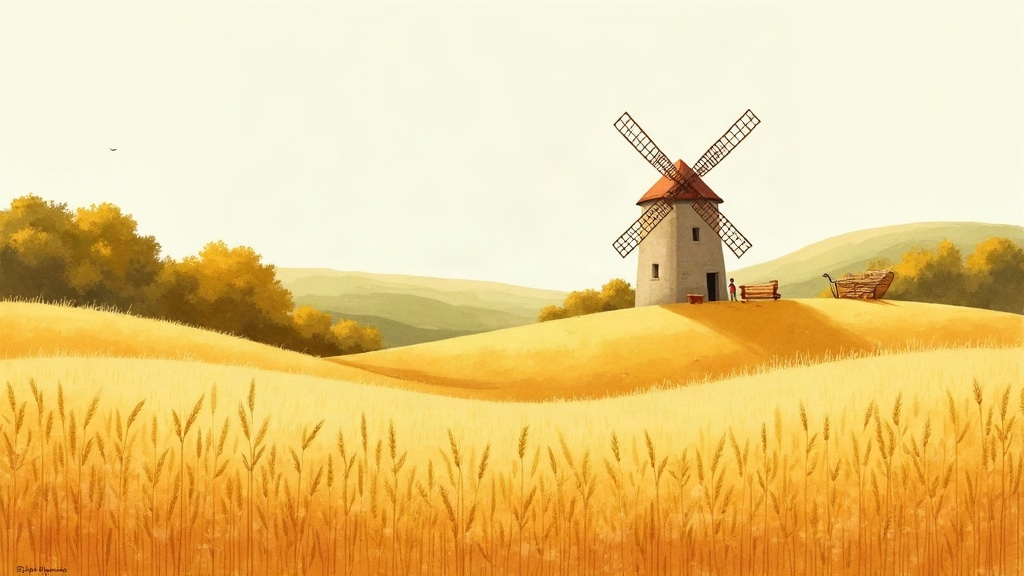
Croissants want a bread wheat with moderate gluten — roughly 11–13% protein (a UK Group 1/2 milling variety, or the French T55 style). Strong enough to build sheets that trap the butter, not so strong the dough fights you and tears the lamination.
In Wales? Marginal but doable. We’re one of the wettest corners of the UK, which historically favoured oats and grass over wheat — the damp raises disease and makes ripening a gamble. Sow winter wheat in Sept–Oct for a late-July/August harvest (or spring wheat as a wet-ground hedge), then pray for three dry days to bring it in.
How much land? If you bake ~2 kg of flour a week (~100 kg/year), you need ~130–140 kg of grain. At realistic hand-plot yields that’s roughly a 25 × 25 m plot (~600 m²). Rule of thumb: ~100 m² ≈ 15–18 kg of flour.
Grain → flour: cut it, thresh it (beat the grain free of the ears), winnow it (let the breeze carry off the chaff), dry to ~14–15% moisture so it doesn’t mould, then mill it — a stone mill runs cool and traditional. That first pass gives wholemeal; sift (bolt) out the bran and germ to reach the ~72–75% extraction white flour that laminates cleanly.
🚜 The Welsh arable farmer: “Wheat’ll grow here, mind, but the weather sets the rules. Half the battle is drying the grain before it heats in the store. For a croissant flour you don’t want the strongest gluten going — a clean, moderate-protein bread wheat, stone-ground and well sifted, so the dough sheets out for the butter without fighting you.”
🐄 Butter → you need cows (at least four)

The heart of a croissant is butter, and butter starts with a cow. The classic choice is a Jersey — small, docile, and prized for high butterfat (~4.5–5.3%) with big fat globules, so the cream rises fast and churns easily.
You can’t keep just one. Cows are herd animals; kept alone they get genuinely lonely and stressed. Minimum two, but two can still feel thin — for a contented little herd we’re going with four, so there’s always company even when one is dried off before calving or away being served. A companion can be another bovine or, at a pinch, a calm sheep/goat/horse (watch the copper — cattle minerals can poison sheep).
Land & feed: reckon ~1.5–2 acres of pasture per cow for the grazing season — so four cows want roughly 6–8 acres — plus land to cut hay. Wales’s wet, mild climate grows grass beautifully spring-to-autumn — the catch is winter: you’ll need roughly 2 tonnes of hay per cow — about 8 tonnes for a herd of four — for a Welsh winter, plus dry housing. And water — a milking cow drinks 45–90+ litres a day.
A place to live: a field shelter for sun and driving rain, and a light, airy, draught-free winter byre with a dry bedded area so she’s not standing in Welsh mud. Stock-proof fencing throughout.
Milk → butter: she only lactates after calving, so she must calve about once a year to stay in milk (no calf, no milk — the bit everyone forgets). Then: skim or separate the cream → churn it until it “breaks” into butter and buttermilk → wash it in cold water until it runs clear → work in a little of your sea salt. A single Jersey gives far more milk than a household can use, so butter-making is really about managing a happy abundance (the buttermilk goes into your baking; the skimmed milk feeds the calf).
🐄 The Welsh smallholder: “People fall in love with golden Jersey butter — but a house cow ties you to the yard morning and night, come rain, and in Wales it mostly comes rain. Get two, or a calf at foot at the least. The grass is a gift; it’s the winter that catches folk out. Keep her in calf every year or the milk stops, mind the TB testing and the paperwork, and never miss a milking. Do all that and you’ll churn butter like you’ve never tasted from a shop.”
Reality check: twice-daily milking, 365 days a year; year-round mucking-out; annual breeding and calving; and in the UK a cow is a registered, ear-tagged, TB-tested, movement-recorded animal — not a pet. It’s a lifestyle, not a hobby you can pause.
🧂 Salt → the easy one (thank the sea)

This is the most achievable “from scratch” ingredient in Wales — we have ~2,700 km of coastline. Wales’s own Halen Môn (Anglesey Sea Salt) is the only PDO-protected sea salt in Britain — PDO stands for Protected Designation of Origin, the legal scheme (same one behind Champagne, Parma ham and the Cornish pasty) that says only salt made in that exact place can use the name — and it started with the founders boiling Menai Strait seawater in a pan on their kitchen stove. The home method is the real method: collect clean seawater, filter it through muslin, and simmer it down until flaky crystals form. (About a litre of seawater gives only 25–35 g of salt — slow, but simple.)
🍬 Sugar → the honest one (it’s beet, and it’s hard)
In Britain, sugar comes from sugar beet, not cane. You can grow beet in a Welsh plot (it likes drier ground, but a small crop is fine). The catch: getting to pure white granulated sugar at home is effectively impossible — that needs industrial purification. Realistically you scrub, chop and simmer the beet, strain it through muslin, and boil the liquid down for hours into a dark beet syrup. It’ll sweeten your dough and feed the yeast; it just won’t behave exactly like refined sugar. Honesty over Instagram here.
And watch the rodents. A sweet root crop is a magnet for voles, mice and rats — and your stored grain (from the wheat) is an even bigger draw. Defend both with rodent-proof storage (sealed metal bins for grain, a well-managed clamp for roots), timely harvest, and traps. The classic organic solution, though, is deliciously on-brand: a couple of good farm cats. Bubbles & Squeak aren’t just the narrators of this story — historically, cats are the pest-control department. The croissant dream and the mousers turn out to be the same project.
🔥 …and one more thing: you need to bake it
Here’s the step it’s easy to forget when you’re busy milking cows — a raw laminated pastry isn’t breakfast. You need an oven, and it has to hit around 220 °C. That electric oven is quietly the end of another long chain (a power station, a grid). The truly from-scratch answer is to build a wood-fired brick or cob oven — clay, sand and stone you could dig locally — and fire it with seasoned firewood (which means a woodpile, an axe, and having cut and dried the wood months in advance). A wood oven roars past 220 °C easily; the skill is reading the heat without a dial. It also gives the croissant a faint, wonderful smokiness a domestic oven never will.
🥐 Will it even taste like a croissant?
Yes — but not an identical one, and that’s the best part. Every from-scratch swap nudges the flavour:
- Stone-ground flour carries more of the wheat’s character (and a touch more bran) — heartier, nuttier, a little less airy than mill-white.
- Cultured farm butter from Jersey cream is richer and tangier, with deeper yellow colour and more flavour than block butter.
- Wild yeast brings a gentle sourdough complexity and a slower, moodier rise.
- Beet syrup instead of white sugar adds a faint earthy, molasses note and makes the crust brown faster (keep an eye on it) — and adds a little moisture to balance.
- Sea salt and a wood-fired bake round it off with minerality and a whisper of smoke.
The result is a rustic, characterful, unmistakably hand-made croissant — not a photocopy of the Parisian bakery version, but arguably a more interesting one. It’s the taste of the whole farm, in one pastry.
🫧 Yeast → catch it from the air
Classic croissants use baker’s yeast, but the fully-from-scratch route is wild yeast: mix equal parts flour (yours!) and water, leave it, and feed it daily. Wild yeasts and lactobacilli from the flour and air colonise it; within a few days it’s frothy and alive — a sourdough-style starter that’ll leaven your dough (slower and moodier than shop yeast, with more flavour). Your flour literally grows its own rising agent.
🥚 Egg wash → a few hens
That glossy golden shell is an egg wash, so you need eggs — and, like cows, chickens are social: keep a proper little flock — six hens plus a rooster — in a coop with a run (~3–5 sq ft of coop and ~10 sq ft of run per bird), fed and watered daily. Six hens give you roughly 2–3 dozen eggs a week, vastly more than an egg wash needs. Do you need a rooster? For eggs alone, no — hens lay perfectly well without one. But we want the full farm, so in goes a rooster: now some eggs are fertile, a broody hen (or an incubator) hatches the next generation of chicks, and the flock renews itself year after year. (Fair warning: roosters crow from first light — worth checking how close the neighbours are.)
💧 Water → it’s Wales
The one ingredient we have in absurd surplus. Collect rainwater off the roof (treat/boil it before use). Non-problem.
🚜 So… what did we just build?
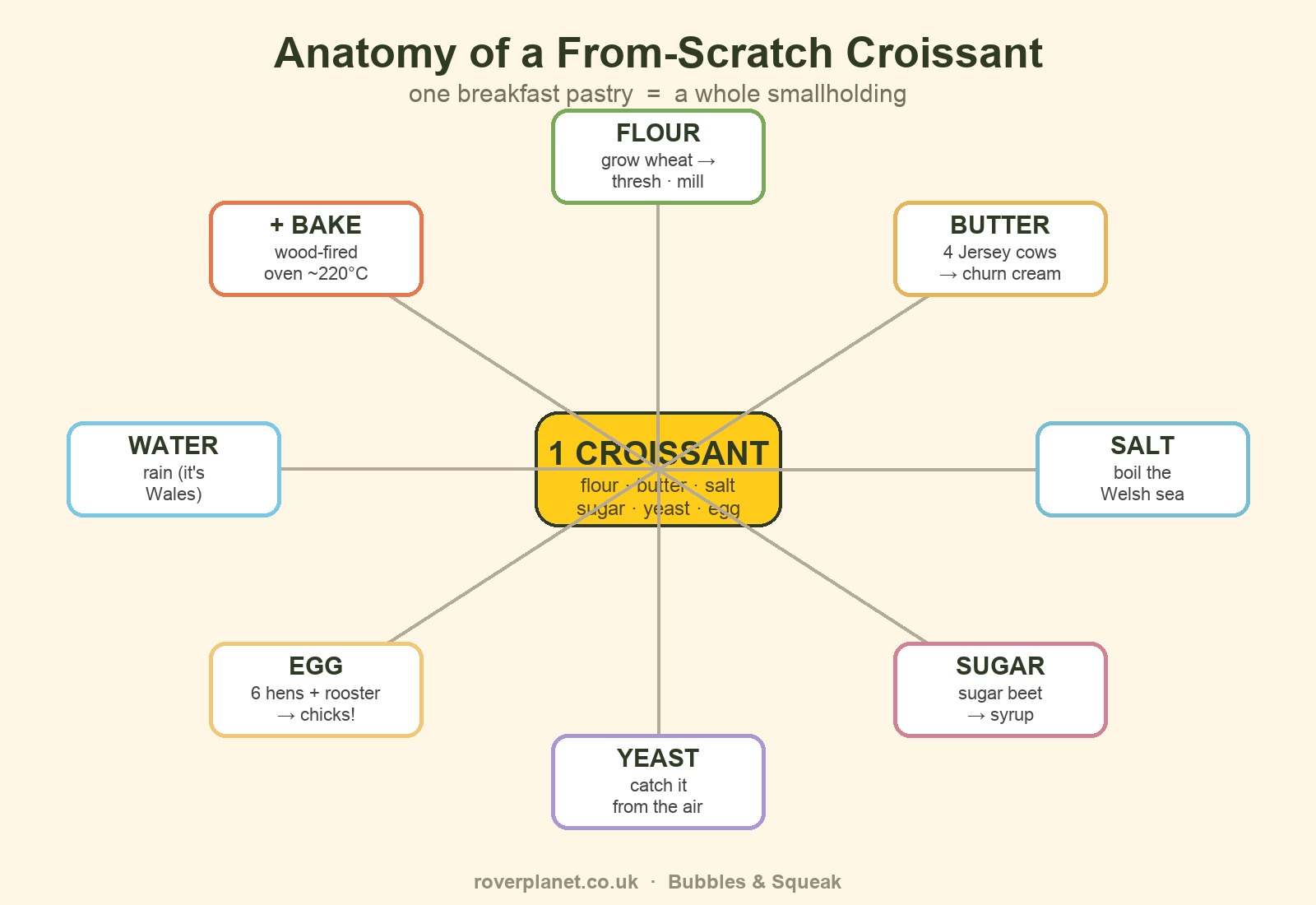
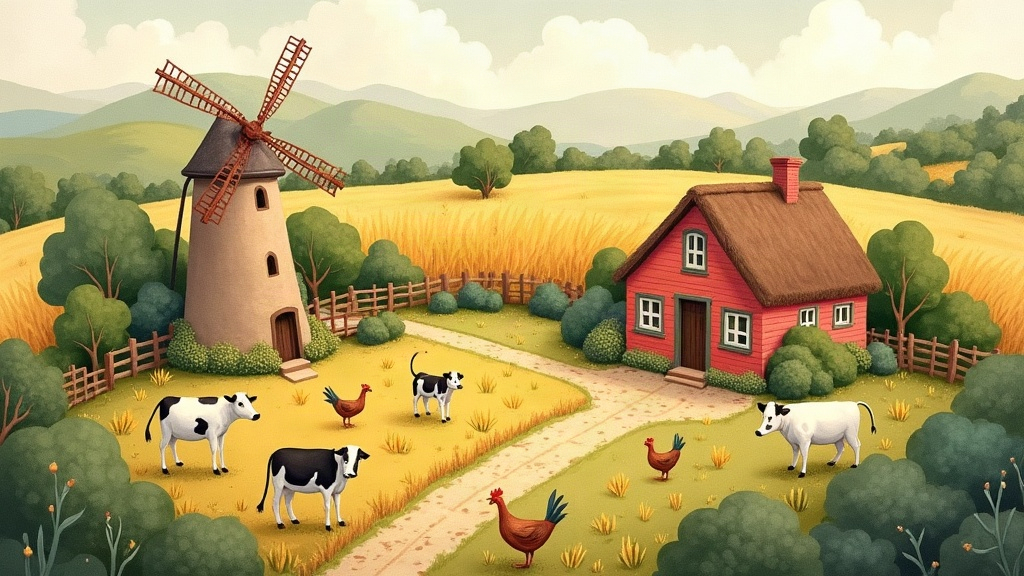
Add it up and the humble breakfast croissant needs: a ~600 m² wheat plot and a stone mill; four Jersey cows on 6–8 acres with a hay meadow, a byre and a churn; a flock of hens; a trip to the coast with a big pan; a bed of sugar beet; a jar of wild yeast; and a water butt. A single laminated pastry, it turns out, is the tip of an entire smallholding.
Which is rather the point. Every easy thing in a supermarket is the compressed end of a long, patient chain of growing, tending, harvesting and craft — and most of that chain is animals and weather and time. You probably won’t build the whole farm for one breakfast. But knowing what stands behind a croissant makes the shop-bought one taste different too — and makes the idea of doing even one link yourself (baking the pastry, catching the yeast, boiling the salt) a lot more tempting.
Bubbles & Squeak, naturally, went all in. Here’s their (heavily abridged, musically enhanced) version of the same dream:
🐾 Fuel your curiosity — more grow-along, science and silliness at roverplanet.co.uk.
How this was made: the illustrations are AI-generated (fal.ai flux) in a storybook style to match our farm cats; the research was pulled together and fact-checked across dairy, arable, sea-salt and baking sources; and the whole thing — blog, animation and song — was assembled with Claude Code. The expert “voices” are illustrative composites for tone, grounded in real smallholder, milling, and pastry sources. Fuel your curiosity.